Image by Rev. Ronald Patrick Raab, C.S.C.
As priests, we lovingly stand at the altar during Mass holding a chalice with wine that becomes the Blood of Christ. If we slow down this gesture and reflect upon such a miracle, we begin to feel what we consume. The Precious Blood of our Savior does not exist only in our hands, but is consumed to bring life to the Church and the world. If we reflect upon such a moment, our hearts break open, and we begin to see ourselves being poured out for the good of the world. We cannot escape such a transformation since we believe in Jesus Christ, whose body was pierced with a sword, and blood and water flowed from his side. We find such beauty and love within our own hearts only after holding such a chalice for many years.
On simple human terms, what a chalice holds does not change the world. Only with faith do we realize that one cup is measure enough to bring hope to our people and healing to our relationships. Only with faith do we become satisfied with what is poured out for us: the love of Jesus Christ. One Cup of Blessing is worth more than we can ever contain or hold in our hands. The Cup of Blessing holds the treasure of eternal life sipped while still on earth.
The chalice carries not only the Precious Blood of Christ but also is brimming with profound memories of our priesthood. The chalice becomes a container for all that is precious to us, a symbol of our ministries and the ecclesiology of our lived priesthood. It is a reminder of the people with whom we have ministered along the way, and the many places, churches, cities, and towns in which we have held the chalice at the altar to proclaim the memory of Jesus Christ.
In these past few years, I have pondered the chalice in new ways. I minister among our elder priests who can no longer hold a chalice because of arthritic hands, or the onset of dementia, or bodily weakness. I have witnessed the death of many of our men, and so often the one possession that winds up in a priest’s last earthly room is his chalice from ordination. The chalice is a treasured gift from the past, but it also reveals many fascinating aspects of his faith journey from ordination to deathbed.
I am intrigued by the various materials from which these chalices are made. Some were crafted before the Second Vatican Council, in gold or silver plate. These traditional chalices remain strong and sturdy and are usually passed down to our young men who are being ordained priests today. Some were designed by our priest-artists and crafted in Rome, where many of our men studied theology before ordination. Some chalices from after the Second Vatican Council, which called for a chalice to be shared among the people of God, reveal a cup that is extra-large. Many handcrafted chalices reflect the challenge to create liturgical art from the hands of local artists in various communities. This sense of inculturation changed not only liturgical vessels, but church structures, vesture, stained glass, architecture, and all Christian art. Other chalices, made of fine-cut crystal or formed from a potter’s clay, may no longer function as chalices but give us insight into how liturgical changes were calling us into witnessing the Divine in the work of human hands.
I contemplate the gift of the chalice as I hold the empty vessel after the death of one of our priests, silently praying on his behalf for all the people he served in all his apostolates around the world. I imagine the Sunday Masses, weddings, and family funerals where his chalice served a community. I understand more deeply the models of theology and training that were important in his journey of faith. When I see an engraving, or a mother’s diamond from her wedding ring embedded on the base of the chalice, I feel the joy his parents must have felt. I pray that the next generation of priests will carry such a gift and reveal to many more communities that Christ’s love is among us no matter how art, style or the practice of theology changes from generation to generation.
On Sunday June 7, 2026, the Church celebrates the Most Holy Body and Blood of Christ (Corpus Christi).
Let us pray:
For all who thirst for healing and consolation. May we sip from the sacred vessel and receive the Real Presence of Christ Jesus. May our thirst remind us of our longing for Jesus Christ and our surrender to the beauty of his redeeming love. May we experience God’s tender mercy and eternal forgiveness. May our thirst for healing be satiated with compassion in the dying and rising of Christ Jesus. May our hearts thrive as we share communion among all people. May the Eucharist call us into genuine concern for every human being and issue on the earth. We pray to the Lord.
For courage to share the Cup of Salvation here on earth. May the Eucharist reveal within us our common humanity, our common search for love and connection. May we dine with people who have no shelter on earth, so we may realize our need to be in communion with God, who boldly protects us. May we dine among people whose hands shake while holding the Cup of Salvation so we may all believe in God who heals our bodies and steadies our ways in daily life. May we feast at the Divine Table so as to imitate God’s plan for all people to be fed and served, to be housed and made whole, to be known in their dignity as human beings. May God’s tender compassion be manifest in each sip we take at the ancient Eucharist. We pray to the Lord.
For all who receive the Cup of Salvation for the first time in the Easter Season. May our children and adults who thirst for Christ know within their hearts the glorious presence of the Risen Christ. May we reach out boldly to accept with our own hands the Cup of Salvation that brings us new life, hope, and inner freedom. May we experience a blessed and new belonging as we receive the Eucharist. May our belonging at Mass be manifest in our service to all people under heaven. We pray to the Lord.
___________________________________________________________________________
About:
Rev. Ronald Patrick Raab, C.S.C., serves as religious superior of Holy Cross House, our retirement and medical facility at Notre Dame, Indiana. He is an award-winning author, blogger, and visual artist. Learn more: ronaldraab.com
Fr. Ron’s Chalice:
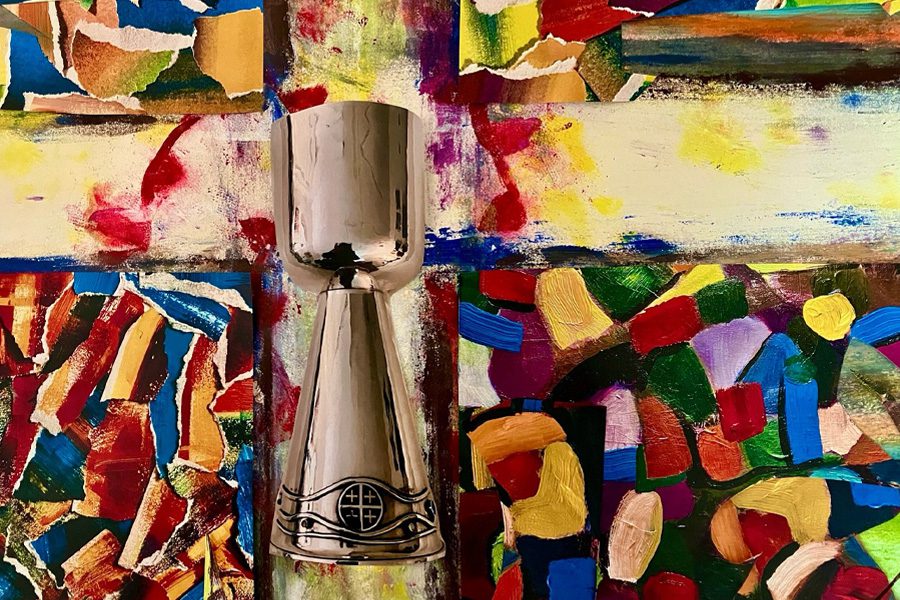
Fr. Ron received his chalice (in photo) from his parents, John and Rosemary Raab, for his priesthood ordination in 1983. Donald Stuart from Ontario, Canada, designed and handcrafted the chalice and paten. Mr. Stuart describes the chalice: sterling silver, 14k gold crosses, inlays of ebony, copper ore, cocobolo, rosewood, caribou antler, and silver ore. The wave of silver around the chalice images our common baptism in the death and resurrection of Christ. The five crosses that image the Jerusalem Cross remind us of the five wounds of blood and water of Jesus Christ. In 1992, the chalice and paten were part of a year-long tour in Canada for the twenty-fifth-anniversary honors of Mr. Stuart’s art and teaching. A similar tour also took place for the artist’s 50th anniversary.
Artwork:
Fr. Ron created this collage with a photo of his priesthood chalice in 2025. Fr. Ron’s artwork has been published in parishes, dioceses, and ecumenical settings around the world.
Provided by Rev. Ronald Raab, C.S.C., April 2026