Photo provided by the NavyTimes, Seaman Benjamin C. Jernigan/Navy
Navy Chaplain and Holy Cross Priest
After serving in the Navy for four years, in 1971, at the age of 22, I met Holy Cross and entered the Candidate Program (today’s Postulant Program). Having been treated well and helped by Navy Chaplains as I discerned and discovered a direction to go in life, I desired to one day return to the military as a Chaplain in order to “pay back” that gift. I was first given that opportunity in 1985.
My first assignment as a Navy Chaplain was with the Marines in Okinawa, Japan. Following that tour of duty, I was sent to a navy base in the Philippines, and later to the USS Midway; an aircraft carrier homeported in Japan. Those first three assignments with the Navy found me somewhat isolated – far from homebase and the Holy Cross community. However, all three drew me closer to and more appreciative of the Holy Cross brotherhood.
There were a few experiences in those distant settings that found me considering who we are together that stretches well beyond geographical proximity or apostolic affiliation. Our Holy Cross Constitutions suggest that “we strive to abide so attentively with one another that we become a sign in an alienated world: men who have, for love of their Lord, become closest neighbors, trustworthy friends, even brothers.” (Constitution 4:42)
An Inner Struggle and New Assignment
While attempting to provide shelter for others amid the challenges and successes in chaplain ministry, I was struggling. I immersed myself in work to distract me from the inner battle. I knew I needed to close this chapter and return to safety, as I found the Navy an intensely secular culture. I wrote the Provincial and indicated my desire to return to parish ministry.
But, during that period of discouragement and decision-making, two significant things happened simultaneously. I received orders assigning me to an aircraft carrier – the heart of the Navy experience and the envy of most every Navy Chaplain. And I confided in a friend – a Navy Nurse – that I was worn out, discouraged and divided. While these new orders were an exciting invitation and challenge in ministry, I felt the need to return to the security and support of community life. She asked me: “Now tell me again, what’s the name of that group you’re a part of?” I said: “Holy Cross.” She said: “Holy what?” I said: “Holy ‘Cross’.” She said: “Oh, and what does that mean?” I read to her Constitution Eight – “The Cross, Our Hope.”
The Provincial gave me permission to remain in the Navy through one more assignment. The nurse’s question had moved me to reflect more deeply on my relationship with Jesus, His Cross – our only hope – and on my relationship with the brotherhood and our ministry in His name. The choice to remain in the Navy became a significant time of conversion and recommitment for me; both to the Lord and to the Holy Cross community.
Responding to the Call
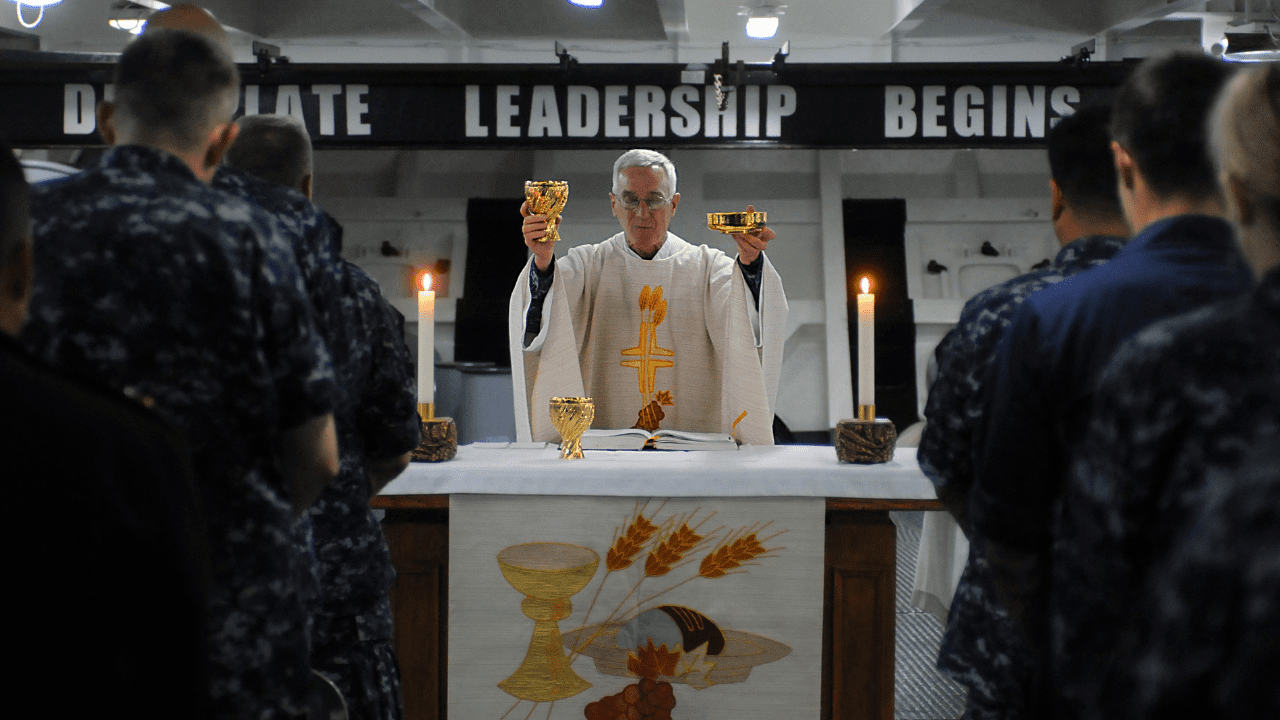
It was a beautiful day in June. After having had some repairs done to the ship in our homeport in Tokyo Bay, we were to go to sea for a brief period to check out the repairs and do some training prior to embarking upon a six-month deployment to the Persian Gulf. I had been the Catholic Chaplain on board the USS Midway for two years, with more than eighteen months at sea, and had experienced a renewed relationship with God and Holy Cross. I was able to visit the community yearly and corresponded with my brothers in religious life more often than before, and appreciated the community’s presence. Praying the same Divine Office and celebrating daily Mass, the spiritual communion that holds us together across the globe was tangible and critical.
After two days at sea, during the daily, noon-time Mass, the fire bell sounded. None of us were too alarmed because fires often occur aboard a carrier. We just listened for the fire’s location and offered a prayer of thanks and petition for the firemen who would respond. After Mass, as usual, I went for lunch. About the time I sat down at the table, the medical emergency alarm rang; again, a daily event on a ship with 5,000 people aboard. But with this alarm, the Chaplain is supposed to respond along with the medical team, so I left my lunch and headed for the announced area.
Suddenly, both alarms rang out in my memory, and I made the connection between the fire and the injury. My heart quickened, as did my pace. I ignored the orders of a Marine directing traffic around the secured fire zone and came upon a clear area to where firemen were hauling the victims of an explosion that had happened three decks below. There were screaming boys clothed only in blackened, charred skin. There were silent, shocked men whose faces were white with horror.
My heart stopped, then it raced. I wanted to scream; I wanted to run and hide. In mere seconds my mind raced through time. I thought of my brothers in Holy Cross – spiritual directors who had encouraged and blessed me over the years; mentors who had trained and trusted me for two decades; friends who had challenged and supported me up to this terrifying moment. My spirit turned to them asking: “What am I to do?” What would Fr. Joe do? What would Fr. Tom do? What would Bro. Clarence do? What would Jesus do? I did what I was called – supposed – to do. I blessed the dying. I prayed with the wounded. I attempted to console the frightened and the weary. It was the worst day of my life, and I tried to do my best. I think I was at my best because of my relationship with the Lord and because of my renewed relationship with the Holy Cross community.
Brotherhood in the Dark Tomb
It took nearly 24 hours to douse the blaze and clear the smoke. That one day seemed like an eternity. But, when it was over, it seemed but a moment. When the roll-call was complete, two young crewmen – two young Catholics – could not be accounted for among the dead, the injured, or the horrified. When the fire ravaged area had been drained and made safe to enter, I was to be there to bless the space and their remains.
Prepared for more devastation and another horrible scene, I bit my lip and uttered a silent prayer. But I was not ready for the blessing we were about to receive as we were confronted with the two charred, unrecognizable figures in their dank, dark tomb locked in one final embrace. In the frightening darkness, in the breathtaking smoke, in the intense heat, the two youngsters had found each other and clung to a spirit that carried them beyond death to a new life. In their pain and in their struggle, they could have remained isolated, alone, and strangers. But, in their desire to cling to life, they chose to find and hold one another as they moved beyond this world.
In moments of personal struggle and vulnerability, I can often isolate myself and cling to the world’s promise of life, but the brotherhood challenges me to reject its fascinations. When the intensity of life knocks the breath out of me and I choke on self-doubt and fear, the brotherhood encourages and refreshes me with the embrace of the Spirit. When I fail to recognize that I am occupying that dank, dark tomb, the brotherhood testifies to the Promise of the One who welcomes me beyond death.
To have a future serving God and the people of God — to be apostolic religious today — we must be attentive to one another. In an increasing secular world where, in both the local neighborhood and the university classroom, the credibility of faith and religion is contested; in a scandal-ridden Church where good religious struggle to be faithful, we must trust one another – we must, as our Constitutions suggest, refresh, fortify and protect one another.
“….we strive to abide so attentively with one another that we become a sign in an alienated world: men who have, for love of their Lord, become closest neighbors, trustworthy friends, even brothers.” (Constitution 4:42)
By Fr. Bill Dorwart, C.S.C.
Provided by Vocations Office, March 9 2026