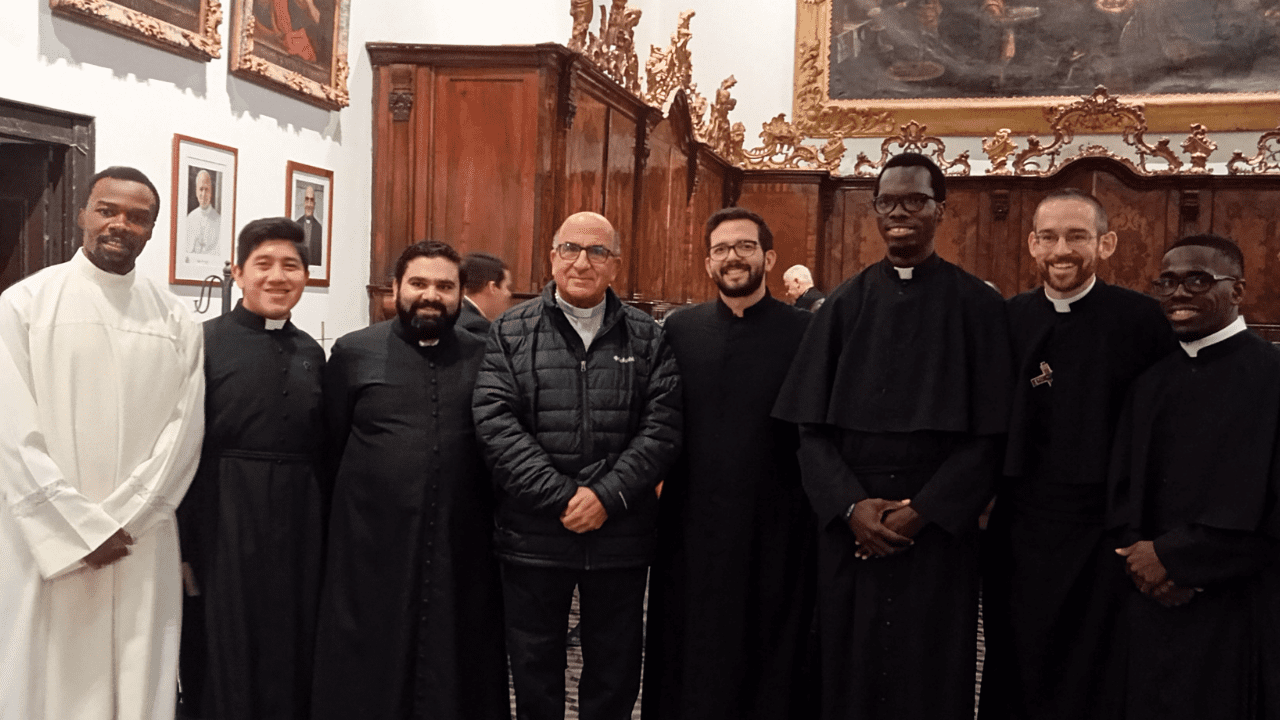
Photo of Fr. Zach Rathke, C.S.C., and Holy Cross men in formation with Cardinal Fernando Chomali, the Archbishop of Santiago
By Fr. Zach Rathke, C.S.C.
The Weight of Self-Doubt in Discernment
I vividly remember the self-doubt that plagued me as I discerned religious life. I felt inadequate. For instance, I easily imagined lacking both the courage and capacity to speak and lead within the diverse settings of priestly ministry. I pictured myself paralyzed, unable to respond to confessions of grave sins or the heart-wrenching cries at the bedside of someone receiving a terminal diagnosis. I also felt intimidated by the formation community, which seemed filled with men of tremendous talent, holiness, and knowledge of the faith. My discernment fixated on what I perceived to be my core weakness: timidity. I repeatedly asked myself—and God—if entering formation would simply expose that weakness and set me up for failure.
The True Purpose of Religious Formation
The truth was that I operated under a fundamental misunderstanding of religious formation. It is not an award for those who have already achieved a certain level of holiness, knowledge, or pastoral skill. Formation seeks to do exactly what the word implies: to form those who are not yet fully formed. In fact, Blessed Basil Moreau, CSC, states in the original constitutions of the Congregation of Holy Cross—and reiterates in his circular letters—that the most fundamental purpose of our community is the sanctification of its members. To faithfully proclaim the Gospel and thus sanctify the world, we must first be sanctified ourselves:
“Thus sustained by grace, we shall be able to work for our neighbor’s salvation without endangering our own, and to devote ourselves to works of apostolic zeal without forgetting that task which should be our constant care and without which the others cannot succeed or at least will be of no avail – the work of our personal sanctification.” (Circular Letter 104, Blessed Basil Moreau, CSC)
Weakness as a Starting Point, Not a Disqualification
In my current ministry as a formator in Santiago, Chile, I have learned that my initial doubts and questions were actually a healthy sign. Everyone who enters a formation house arrives with personal weaknesses. Everyone! We are all fallen human beings. When someone begins the difficult work of recognizing their flaws and their need for the Lord’s strengthening grace, they have already set out on the journey toward personal sanctification.
When John the Baptist prepares the way of the Lord, he does not call the perfect. He calls sinners to repentance. He asks them to recognize their brokenness and realize that God alone can truly heal and save them. He then invites them to receive healing grace, washed in the tender mercy of God through baptism. From there, the Savior can arrive at their hearts and guide them on the journey to holiness. The apostles are the ultimate example of this. Jesus did not call perfect people to be His apostles. Even the chief among them stumbled repeatedly during his formation with Jesus, eventually denying Him in His darkest hour.
The Danger of Striving to Appear Already Formed
Conversely, when a young person in formation fails to realize his own weaknesses and strives instead to impress his formators and peers with his holiness or talent, it gives me pause. Sometimes, a young man builds up resistance to acknowledging his flaws, seeking only to prove his competence and sanctity to himself and others. Yet, a doctor cannot begin treatment until arriving at a diagnosis. If a patient refuses to face the discerning eye of the physician for fear of what might be found, the hidden illness will only remain and grow.
Trusting the Work of Formation
Do not be afraid! Formation—and indeed, the whole of the Christian life—invites us to place ourselves before the loving, discerning eye of the Divine Physician to be brought to healing and wholeness. It is true that one must possess a baseline of maturity, holiness, and capacity to be a sound shepherd of God’s people. Yet, you do not have to determine that on your own. Vocation directors and formators are trained not only to discern your aptitude for religious life, but also to guide you along the path of personal sanctification. Let them do their work! Your part is to remain humble, graciously accept feedback, strive to grow in holiness, and trust that Divine Providence will guide you no matter what comes, even if you face rejection.
Therefore, if you feel inadequate to enter religious life for any reason, be at peace! Do not let your self-doubt bar you from responding to your call. In fact, you have already taken the first step: humbly recognizing your weaknesses and your need for saving grace. Call out for His tender mercy and ask Him to show you the path to personal sanctification. Ultimately, that is the fundamental purpose of every vocation—whether to religious life, the priesthood, marriage, or a professional career. A vocation is our pathway to holiness, which in turn becomes the means by which God sanctifies others through us. If God is calling you to religious life, your acceptance into a formation program would not be a reward for your holiness, but an invitation to embrace your weaknesses and to let yourself be formed ever more completely into a living image of Jesus Christ.
Provided by the Vocations Office, June 17, 2026.
.