Photos provided by Michael Jezewak, assistant director of the Holy Cross Mission Center
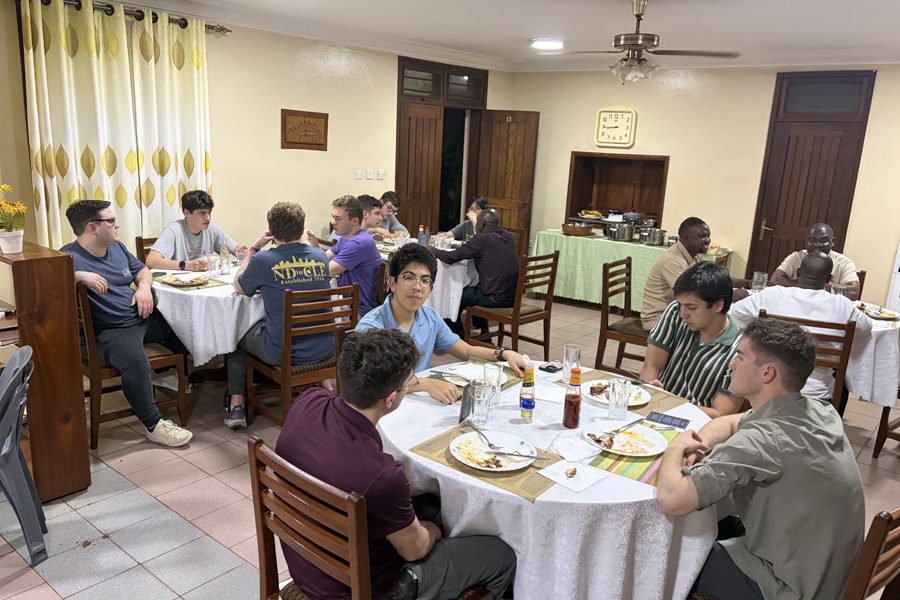
Breakfast at Bishop McCauley House, located in Nsambya, Kampala, Uganda, is a standard practice of community life. The Holy Cross priests and brothers leave their private rooms, pass by the tranquil courtyard in the center of the community residence, say Morning Prayer together in the chapel, and then head across the courtyard for breakfast in their dining area. Though there are only a handful of permanent residents at McCauley House, there are four dining tables, each with four seats, to accommodate visitors like myself from the United States and, more commonly, other Holy Cross religious from the Province of East Africa who are in town for meetings or ministry.
On March 9, 2026, midway through my rapid-fire, 8-day tour of Holy Cross ministries in the Kampala, Jinja, and Fort Portal regions of Uganda, I was fortunate to join the Congregation’s men for breakfast. Having learned about Ugandan Empaako, or “pet names,” in pre-immersion formation sessions from seminarian Keenan Bross, C.S.C., I took this opportunity to inquire a bit about them. “How do you get a ‘pet name’?” “Can I get one?” The conversation led to several aspects of East Africa’s more formal naming conventions that, to my American ears, left me fascinated.
Fr. John Mwesige, C.S.C., my Holy Cross interlocutor, shared that up until two or three decades ago, most Ugandan parents followed traditional East African naming conventions whereby the child’s name was based on the material or social circumstances of his birth. For instance, he cited several factors that had been used to name people he knew as adults:
- The mother’s infidelity,
- The child’s birth taking place while in transit to a hospital,
- A family feud with another family that was ongoing at the time of the child’s birth,
- The mother’s prior miscarriages, and
- An emotion, desirable or not, that the infant child prompted in the parents.
For Americans like myself, I suspect this sounds mortifying. Introducing oneself as ‘Destined for the dirt”—essentially the English equivalent of a name that Fr. John knew of for a grown man whose parents did not expect him to live much past infancy due to the mother’s prior miscarriages—sounds unfathomable in our social context.
Fr. John and I both acknowledge such names could be a heavy weight to bear throughout one’s life. They could feel like they trap a person inside some particular brokenness of the world that their parents experienced around the time of their birth. Everyone comes to know some of the brokenness of their parents and the world as they mature, but hopefully not with such raw details attached to their name!
Fortunately, Fr. John intoned, those naming conventions have largely changed in recent decades as African traditional religions have been overwhelmed by Christianity and Islam, which bring with them their own naming conventions. Nowadays, Ugandans’ names are often quite explicitly religious. For instance, Fr. John’s official name (which I forget exactly) literally means something close to “desired by God.” And of course he also received “John” as his “Christian name,” a common expression I heard in East Africa to refer to names that are not official government names. These religiously infused names, I remarked between bites of my omelet, point the recipients towards the transcendent or heroic virtue, a notable departure from the names that tethered earlier generations of Ugandans to some uncontrollable, oftentimes undesirable past circumstance. “Yes, that is true,” Fr. John said.
In the spirit of cultural exchange, I took the opportunity to outline the common American naming convention: a given first name, given middle name (which is not common in East Africa), and the father’s surname (also not common in East Africa, I learned). For many Catholic and other Christian Americans, the given name may honor a saint or Biblical figure, hence the preponderance of Thomases and Jameses and Peters among the members of the U.S. Province! (In my work with the U.S. Province, I frequently find myself addressing emails to C.S.C.s with their last name included just to ensure they know I’m not addressing the wrong “Fr. Tom” or “Fr. Bill”!)
As the meal was winding down and men were beginning to eat their desserts—bananas and mangoes, not brownies and ice cream, as I had to explain to my young children upon returning home—I inquired about the process of giving children names. Fr. John explained that for some Ugandan tribes, names are formally given a few days after birth in a ceremony of sorts that involves a traditional meal with a local bread. For girls this ceremony occurs three days after birth, though for boys the custom is to hold it on the fourth day. When I asked why, Fr. John acknowledged it was a good question but simply said, “That is what the culture passed down.”
This seemed a fitting stopping point for my inquiries as an armchair sociologist, prompting me instead to reflect on the givenness of the world we enter and the names we receive.
Provided by Michael Jezewak, assistant director of the Holy Cross Mission Center, April 2026.