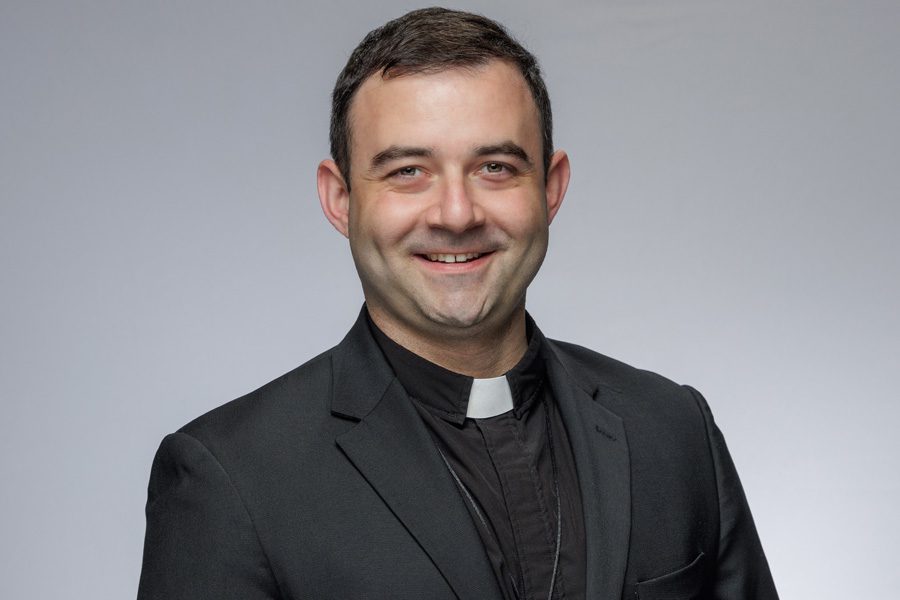
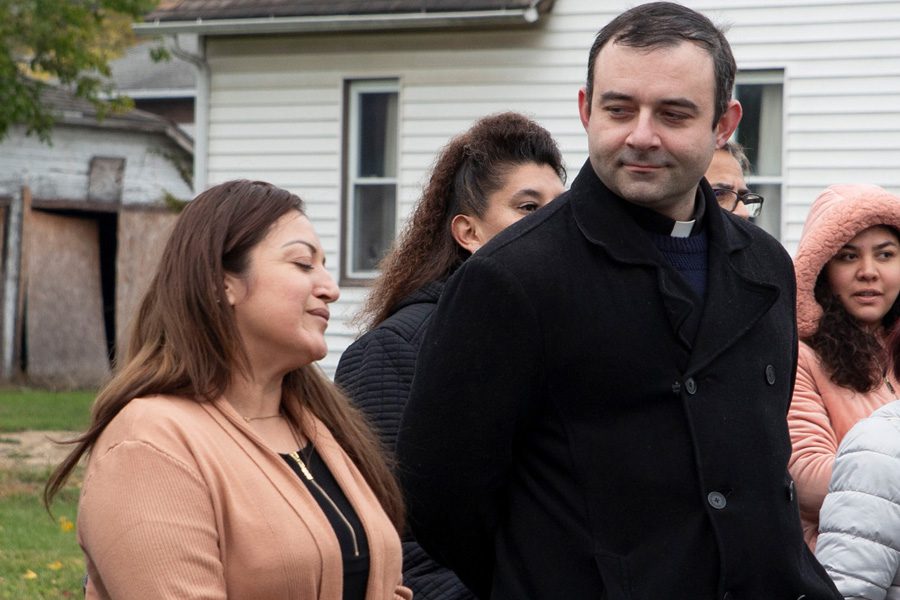
Rev. Ryan J. Pietrocarlo, C.S.C., walks with parishioners during a Día De Muertos procession. Photo by Lisa Kochanowski.
Congregation of Holy Cross-staffed churches and schools are nestled in communities with rich history, deep faith, and diverse cultures. They are neighborhoods filled with generations of inhabitants who have built more than a home, but a community. As a brotherhood bound together in service to the Church, as a family serving families, Holy Cross strives to preserve the identity of the community, foster social cohesion, and provide stability for future growth.
St. Adalbert Parish and St. Casimir Parish were both founded by Polish-Americans, but today are very culturally diverse parishes offering Masses in Spanish, as well as English. In 2003, the two parishes were united under one pastoral team staffed by the Congregation of Holy Cross. Led by pastor Rev. Ryan J. Pietrocarlo, C.S.C., the pastoral team strives to incorporate important spiritual moments for both cultures.
Unique cultural traditions
“One big tradition during Christmas time is the opłatki (a Polish Christmas wafer), which is very popular. We have a group here who will practice that with a Christmas dinner. They will teach people how to do the opłatki, which is very beautiful,” said Fr. Pietrocarlo. “Our Hispanic community has shown interest in this and asks, ‘What is this and how do you do it?’ The tradition is to wish someone well for the new year, and they (the Hispanic community) love it. So even they take it home, and they’ve begun doing it for Christmas meals too. It’s very beautiful. It’s neat that that’s kept alive here from the Polish tradition, but now our Hispanic community has come into liking it as well.”
The Hispanic community celebrates several different customs throughout the year. One prominent celebration is the Day of the Dead, celebrated in November. An altar is prepared in the church by parishioners.
“They bring in pictures of their deceased loved ones, and we pray for them. Our Polish parishioners also bring photos of their deceased loved ones for the altar as well,” shared Fr. Pietrocarlo. Another custom in Latin America and in Mexico is to visit the cemetery around the Day of the Dead. That same custom has begun at the church. “We will go to St. Joe Cemetery and do a prayer service. We have Polish and Mexicans alike come. During the service, they have a chance to go visit their loved ones or tombs. The Polish love that tradition, that they can pray at the cemetery and go see the loved ones,” noted Fr. Pietrocarlo.
The Posadas in December are a popular celebration. It is a nine-day celebration, a novena for Christmas that includes a rosary.
“It’s a reenactment of Mary and Joseph asking for a room in the inn. The word Posada means inn in English. Each ministry will take a night, and they will lead a Posada. People dress up as Mary and Joseph and pretend to ask for a room at the inn,” said Fr. Pietrocarlo. Visitors say a rosary and share a meal. Over the years, he has seen more and more Polish people visiting to learn more about the custom.
Common ground
One thing that both cultures bring to the church community is a deep devotion to the Virgin Mary. In the Polish community, reverence is placed on Our Lady of Czestochowa (also known as the Black Madonna), and in the Hispanic culture, a profound adoration is shared for Our Lady of Guadalupe. Each community recognizes another’s devotion, igniting shared admiration and faith. Through artwork and statues, curiosity about each culture’s devotion has led to education and a deeper appreciation for cultural customs.
“The year is filled with different activities, which is a lot of fun,” said Fr. Pietrocarlo, noting how honored he is to be able to preserve these important spiritual moments for both cultures.
Tradition impact
Fr. Pietrocarlo comes from an Italian and Irish background and has appreciated the opportunity to get to know the traditions of the Polish and Hispanic communities. He has found that his newfound knowledge has had a tremendous impact on his religious life.
“I very much fell in love with all these different spiritual expressions,” shared Fr. Pietrocarlo. The love each culture has for the Virgin Mary through Our Lady of Czestochowa and Our Lady of Guadalupe has had a profound impact on his prayer life. He is inspired by the parishioners and groups that have formed to participate in regular praying of the rosary. “I’ve grown in my own love for the Virgin Mary, particularly as a mother to priests.”
Experiencing the intense love and admiration for deceased family in Hispanic culture has been impactful for Fr. Pietrocarlo. The tradition of the Day of the Dead and the importance to the community of praying for the dead beyond Mass and the funeral is meaningful.
“I love the opłatki; that is such a cool tradition. I did not know that tradition at all coming in and just a sign of unity and well-wishing of others is very beautiful. It fosters community a lot. The idea of needing to wish someone well and blessings for the New Year is very powerful. That’s helped me a lot too,” said Fr. Pietrocarlo.
Community impact
One of the first things Fr. Pietrocarlo noticed when he joined the parish community was a neighborhood filled with issues of poverty. Both the Polish and Hispanic communities came to the United States as immigrants with little to no money. Life has included stress and constraints of limited income and language barriers, forcing families to live a very simple life, often living paycheck to paycheck.
“It’s been hard to see that, because there’s a lot of suffering that’s involved in that. It’s a hard life. But also, I think that’s been a root of great faith in both communities because there’s been this dependence on God. They don’t have anything. They have to have hope that God’s with them, and they do,” said Fr. Pietrocarlo. While both communities are living with suffering, both remain positive through their faith that God is with them during their hardship.
“That’s impacted me a lot. It’s hard to see this poverty, but the hope that they bring is very much the prayer of Holy Cross. They see hope in the cross,” said Fr. Pietrocarlo.
The immigration and deportation issues have been a great challenge for the Hispanic community. Fr. Pietrocarlo said that through the angst, he has found that fear has not deterred Mass or school attendance. Parishioners see the church as a safe place.
“Even in this time of fear, they want to come to the Lord, to have the Eucharist, and to receive his love, and to overcome that fear. It’s been a very powerful witness of faith to me,” said Fr. Pietrocarlo. The suffering is there, but there’s a lot of hope, and there are a lot of expressions of faith that have really impacted me personally.”
“It’s been a blessing to be here, and I’ve learned so much too. I love to be able to walk with this community, to be with the two cultures – the Polish and Hispanic has been so cool,” said Fr. Pietrocarlo, who started his time at St. Adalbert as a deacon and has been part of the community for the past ten years.
Provided by Director of Communications, Lisa Kochanowski, October 2026.