Photo provided by the Holy Cross Mission Center
The following homily was given by Rev. Mr. Keenan Bross, C.S.C., at the Basilica of the Sacred Heart on the Feast of Our Lady of Sorrows, September 15, 2026.
Two and a half weeks ago, in this Church, three confreres and I made our profession of perpetual vows in Holy Cross—by far one of the most moving experiences of my life. For the most part, I was able to keep it together, which was good, since I had forgotten to carry tissues for myself. After professing, each of us was asked to accompany our mother in the offertory procession, to carry up the gifts. Taking my mother’s hand and walking down the aisle, I could no longer hold it back. Without this woman, not only would I not be here, not only would I not be the man who made Final Vows, but I would not have discovered my vocation to Holy Cross at all. The same can be said for many of us and our mother Mary. At some point in each of our journeys, she, too, takes our hand and walks with us. For those of us in Holy Cross, we encounter her through the chaplet of Our Lady of Sorrows, and the seven dolors: three from Christ’s youth, and four from his passion and death. In these episodes of her life, we come to know her not as a distant queen or a far-off intercessor, but as a mother who accompanies us through the messes and struggles of our discipleship.
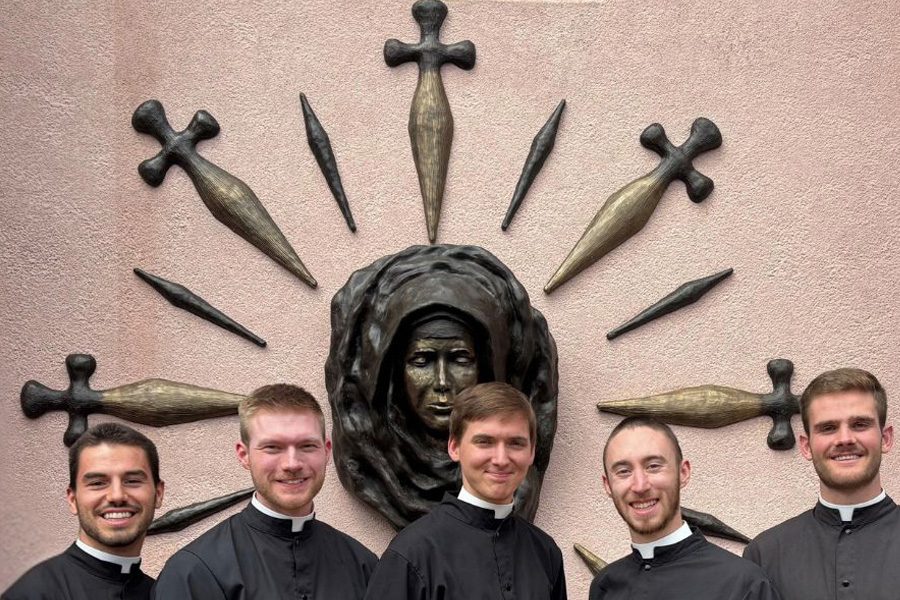
Today’s Gospel (Luke 2:33-35), the prophecy of Simeon, constitutes the first sorrow of Mary and provides Christians with the image we have long used for Our Lady: the seven swords piercing her heart. From the beginning of her call, Mary knew not only that her Son would be special, destined for the rise and fall of many in Israel, but that his great mission would mean great joy and also great suffering in her own life. In 2026, somehow humanity—at least very powerful humanity—seems closer than ever to engineering suffering, even in some ways death, out of the equation of human life. The witness of Our Lady is powerful: the fullness of life is to be found not in a frantic evasion of pain and frustration, but in an embrace of the circumstances of our vocation—that is to say, the Cross. As the late Fr. Tom McDermott, C.S.C., would often say, “In Holy Cross we know that life is holy—that is, it is beautiful, fun, full of joy—and life is the Cross.” If we embrace the sword of Simeon, we proclaim to a world burdened by suffering that true religion is neither escape nor resignation, but a grace-filled embrace of our condition.
The second sword, the second sorrow, is Mary and Joseph’s flight into Egypt in the Gospel of Matthew (Matthew 2:13-15). Warned by an angel of the danger facing their son, they leave everything behind to preserve the life of Christ. Mary knows no compromise: when faced with choosing between the life she knew, and care for her son, she risks everything to preserve his life. Today many people outside the Church are alienated by our compromise—they see more hypocrisy than holiness among Christians. A people who settle for an economy that puts efficiency above all else, who let the technological paradigm take an increasing dominion over our lives and our planet, who see the stranger and the other as a risk and not a gift. What if we, like Mary, were willing to risk our comforts—risk going down from Nazareth to Egypt—to save the life of the suffering and the poor, who are Christ? May we, too, refuse to compromise—even if it takes us to Egypt—and witness to the world the same holiness as of our Mother.
The third sorrow of Mary comes just a bit later in Luke, chapter 2: the loss of the child Jesus in the Temple (Luke 2:41-52). Mary and Joseph’s own blunder and Jesus’s mysterious fate come together for one of the more curious episodes in the Gospel—the scramble by the Mother of God to find the Son of God in the streets of Jerusalem. Our world is also scrambling, looking for God. The aftermath of the Enlightenment and the proliferation of atheism, really, has not been so much the death of God as the search for him in the wrong places. We have cause for great concern that the transcendent questions on the hearts of our young people are being answered by chatbots. Our Lady of Sorrows is no stranger to the search for God. In fact, I believe that in this episode of her life we find a great solidarity with those who are not sure, who are still searching, who struggle to believe. In her solidarity, though, she is also a guide—for in the end, she finds her son in the Temple, and shows us to look for him there too. As her daughters and sons, let us turn to her when we find ourselves struggling to know God’s presence… and may she inspire us to be in solidarity with those who find it hard to believe, as we hope with them for faith.
We could have, my friends, no better patroness for times like these. Let her take your hand and comfort you as you, too, risk everything to follow her son. And as she takes our hands, let her shape us into a Church — and a Congregation — of deep solidarity with the suffering and the searchers. They may just find, as we have, a home in her pierced heart.
Our Lady of Sorrows, pray for us.
Provided by Rev. Mr. Keenan Bross, C.S.C., and the Holy Cross Mission Center, October 2026