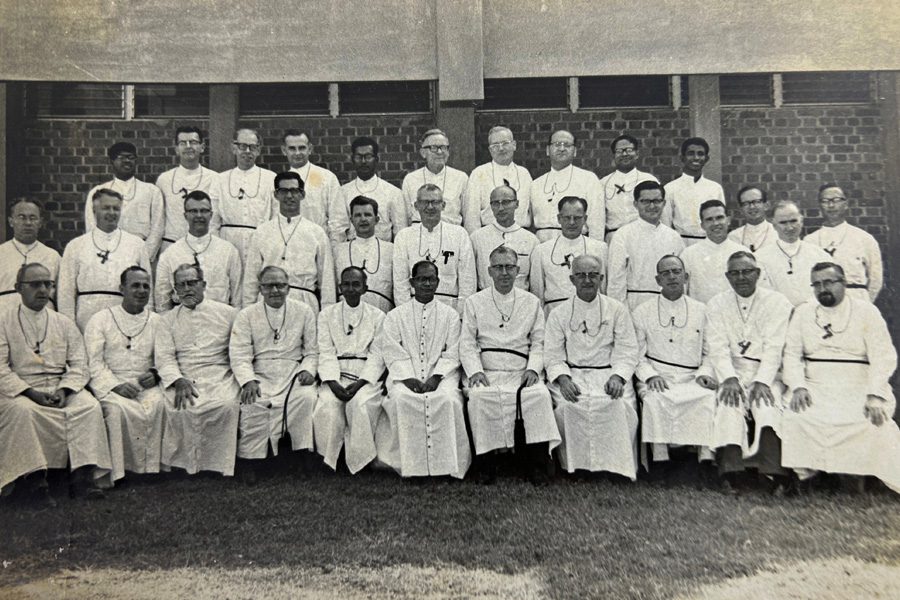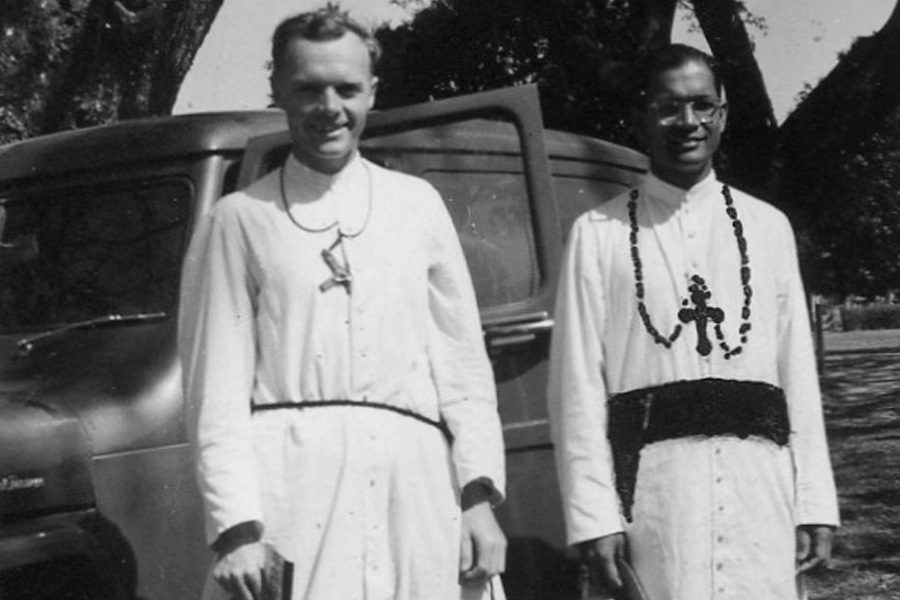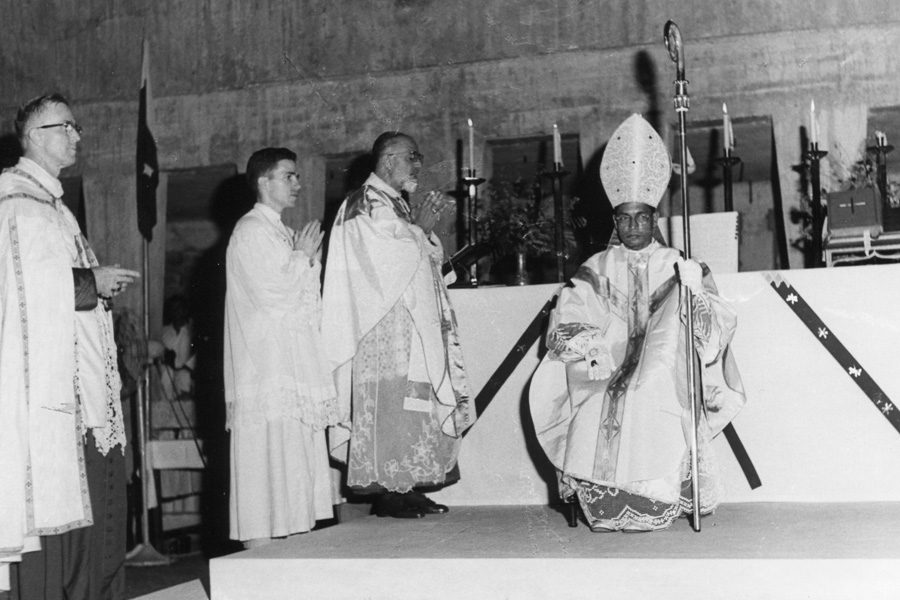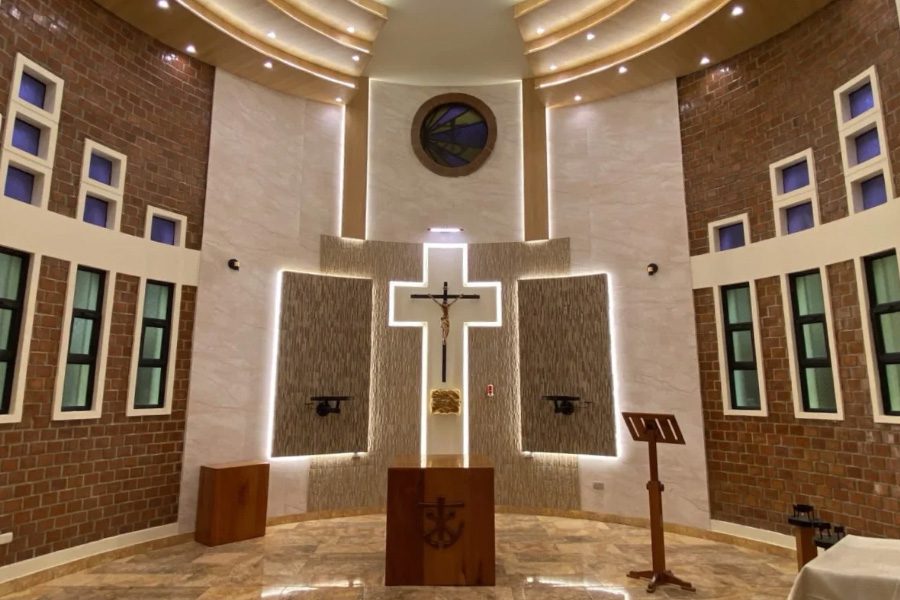
Photos provided by the Holy Cross Mission Center
The following reflection was given by Br. Stephen Binoy Gomes, C.S.C., during a Mass held in observance of the anniversary of the death of Servant of God Archbishop Theotonius Ganguly (C.S.C.) on September 2, 2026, at St. Mary’s Cathedral, Dhaka.
My final meeting with Archbishop [Theotonius] Ganguly, C.S.C., occurred toward the end of 1976. I cannot recall the exact month, but it may have been August or September. At the time, I was residing as an aspirant at the Holy Cross Aspirancy, in Narinda, while preparing for my Higher Secondary Certificate examinations. Suddenly, the doorbell rang. Upon opening the gate, I found Archbishop Ganguly himself standing there. After exchanging greetings, he requested that I direct him to the room of Br. Donald Nadeau, C.S.C., who was our director at the time. Br. Nadeau was a French-Canadian. The Archbishop had brought a letter written in French to have Br. Nadeau translate and read for him. I escorted the Archbishop to Br. Nadeau’s room. I did not have any further significant conversations with him after that day.
On September 2, 1977, ten of us novices were residing at the Diang Ashram. Br. Flavian Laplante, C.S.C., was conducting our class, when, shortly before evening, we received news from the novice Paul Costa that our beloved Archbishop Ganguly had passed away. It was deeply painful for all of us to believe the news of his death.
Theotonius Amal Ganguly was born on February 18, 1920, on the feast day of St. Theotonius, in the village of Hashnabad within the Hashnabad parish. Consequently, he was named Theotonius. His nickname was Amal, which signifies “spotless” or “pure.”
In 1940, he graduated with a First Division Matriculation from Bandura Holy Cross High School, managed by the Brothers of the Congregation of Holy Cross, securing the third position in merit. He was an exceptionally devoted and talented student who routinely stood first in his class, achieving the highest marks in English, Bengali, and mathematics.
He possessed handsome features, a wonderful singing voice, and strong acting capabilities. Annual stage plays were a regular tradition at Bandura Holy Cross High School, and popular accounts hold that he was frequently cast in female roles.
Following his matriculation exams, he traveled to St. Albert’s Major Seminary in Ranchi, Bihar State, India, to study priestly disciplines — namely philosophy and theology. There too, he distinguished himself as an outstanding student and won everyone’s affection through his humility, gentleness, and friendly demeanor. In June 1946, at the age of only 26, he was ordained as a diocesan priest. Following his Ordination, he was posted to Little Flower Seminary in Bandura, where he taught English and Latin to the seminarians.
In 1947, Ganguly traveled to the University of Notre Dame in Indiana, USA, to pursue his master’s and doctoral degrees. He earned his doctorate in philosophy in 1951, becoming the first Bengali Christian to obtain a PhD. Ganguly achieved several historic firsts within the Catholic community of Bangladesh.
During his time at Bandura Holy Cross High School, he had become familiar with members of the Congregation of Holy Cross. While residing at the University of Notre Dame in the United States, he became closely acquainted with the members of the Congregation of Holy Cross and decided to join them. He entered the Holy Cross Novitiate located in Jordan, Minnesota, and took his First Vows on August 16, 1952.
Upon returning to his country, Ganguly began teaching logic at Notre Dame College in Dhaka, a prestigious institution managed by Holy Cross priests. He was appointed dean of studies in 1954, then served as a diocesan consultant from 1956 to 1959, and was appointed assistant principal in 1958. He took his Final Vows in 1955.
In 1960, he was invited to the Pakistan Philosophical Congress by the University of Dhaka and was also invited to the Commission on National Education that same year. He was a wise individual known for his calm and gentle nature, and he was fluent in eight languages.
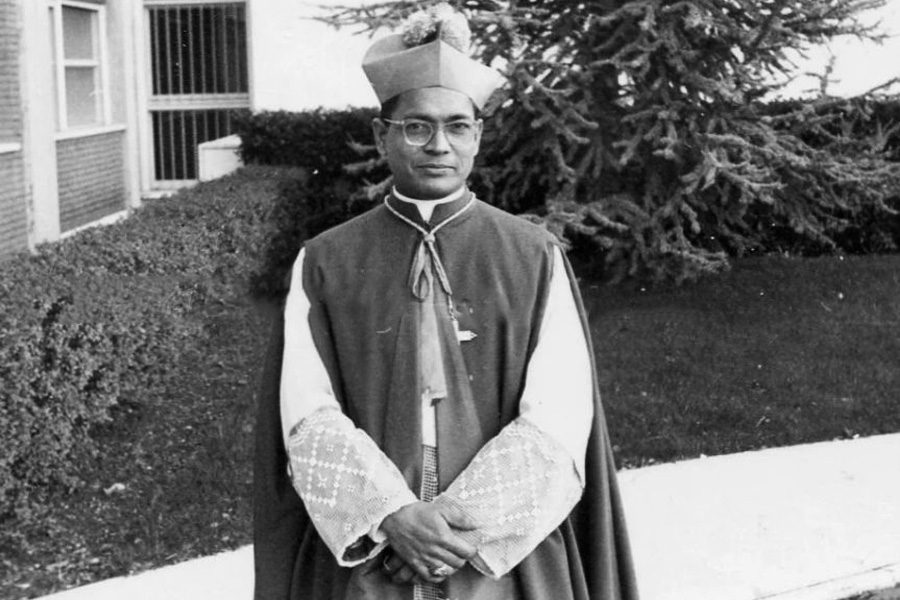
Following the death of the revered Holy Cross missionary Rev. James Martin, C.S.C., Ganguly was appointed principal of Notre Dame College on March 21, 1960, making him the first Bengali to hold the position. However, he did not remain in this role long, as His Holiness Pope John XXIII appointed him Auxiliary Bishop of the Archdiocese of Dhaka on September 3 of the same year. He was 40 years old at the time. The Archbishop of Dhaka during this period was the Most Reverend Lawrence Graner, C.S.C.
Bishop Ganguly received his episcopal consecration on October 7, 1960, becoming the first Bengali bishop. Immediately after his Consecration, he began serving as auxiliary to Archbishop Graner. At a public reception organized on the occasion of his Consecration, Archbishop Graner referred to Bishop Ganguly as the “Day Star.” He noted that while many stars are visible in the night sky, a star visible during the daytime is truly extraordinary and bright. In saying this, Archbishop Graner sought to highlight Bishop Ganguly’s “dynamism, serene spirit, and subtle piety.”
In 1965, Ganguly was appointed Coadjutor Archbishop. Archbishop Graner held the leadership of the Archdiocese of Dhaka from 1947 to 1967, after which Ganguly succeeded him and took full charge of the archdiocese.
Throughout his service at Notre Dame College and as Auxiliary Bishop and Archbishop of Dhaka, Ganguly was recognized as a person who treated every individual’s dignity with utmost respect. He possessed a genuinely spiritual and affable personality. Through his gentle yet firm leadership, he capably guided the Archdiocese of Dhaka through the critical crisis of the 1971 Liberation War.
On September 2, 1977, he passed away suddenly due to heart failure at the age of only 57.
In 2006, the cause for Archbishop Ganguly’s canonization was initiated by the then-Archbishop of Dhaka, Paulinus Costa. His canonization process remains ongoing.
Ganguly was exceptionally humble and modest. Rev. Arnold “Gus” Fell, C.S.C., remarked that he never saw Archbishop Ganguly act in an “authoritative or coercive” manner. Some noted that they had never heard him speak in anger, as he never wished to cause anyone emotional pain. Following his death, various newspapers highlighted his virtues of “humility, sincerity, warm-heartedness, and generosity.”
I cannot recall precisely which class I was in at the time, but when Archbishop Ganguly visited Bandura Holy Cross High School, even as the Archbishop of Dhaka, he touched the feet of his former teacher, Mr. Brajendra, to pay his respects.
I personally observed that every time he uttered the name of Jesus, he bowed his head. Whenever I bow my head upon pronouncing Jesus’ name, I am following a practice I learned directly from him.
He possessed profound empathy and love for the general public. In August 1972, as Archbishop Ganguly’s health began to decline, the Superior General of the Congregation of Holy Cross sent a letter inviting him to Rome to rest for a period. The Archbishop replied to the Superior General: “I feel that it would be a rather uncommon measure not available to the generality of our people. If God should want me to continue to spend myself for his people, I am ready, be it even [from a] sickbed.” He felt that taking rest in Rome would distance him from the common people of his country, which he viewed as inappropriate. His faith in God was resolute, enabling him to affirm that if God willed for him to work for His people, he was prepared to do so even from a sickbed.
Archbishop Ganguly was a person who exerted every effort to bring people together to find common ground. However, it pained him deeply when people accused him of partiality. He faced criticism from those who believed he was reluctant to cause discomfort to anyone. He once wrote to the Superior General of Holy Cross in Rome: “Mentally I have been quite disturbed in recent months by the conduct of some of the men here. At times, I even had the silly and cowardly thought of asking the authorities to transfer me to a place where I may be able to serve God in peace.”
The major challenges and crises Archbishop Ganguly navigated during his ministry include:
- The transition from a foreign missionary-led Church to a local Church structure.
- Pressure and opposition from various sides while attempting to implement the vision of the Second Vatican Council within the local Church.
- The devastating cyclone of November 12, 1970, which struck Bangladesh, followed by the deaths of three priests at the hands of the Pakistani army.
- The nine-month Liberation War in 1971.
- Addressing the multifaceted human needs and post-war chaos following the Liberation War.
- Establishing local Church infrastructure, including secondary and major seminaries that did not previously exist.
- Devoting his full time and energy to serving the general public.
I think that we should conduct more research on this great individual. This will enable us to know him better and adopt him as a role model. In today’s value-degraded society, this noble personality can serve as an ideal and an inspiration for our journey.
In conclusion, I pray to Almighty God that the process of Archbishop T. A. Ganguly’s canonization may be expedited, and that he may be officially recognized as a saint.
Reference:
Bangladesh Mondolir Gourab Archbishop Ganguly (Archbishop Ganguly: The Pride of the Bangladesh (Church) by Bernard Swapon Gomes, (Dhaka: Archbishop T.A. Ganguly Memorial Trust, Archbishop’s House, 1988)
Isshorer Shebok Theotonius Amal Ganguly Bangladesh Mondolir Gourab (Archbishop Amal Ganguly: The Pride of the Bangladesh Church, Published by Archbishop T.A. Ganguly Memorial Trust, Dhaka, Archbishop’s House, 1 Kakriel, Ramna, Dhaka, Bangladesh, 2 September 2019.
Provided by Br. Stephen Binoy Gomes, C.S.C., from the Congregation of Holy Cross’s St. Joseph Province in Bangladesh, and the Holy Cross Mission Center, October 2026